
Resources
My story and why I started the Leading Voice Method


Childhood
My voice as a child
Before I started school, my grandmother wondered if there was something wrong with me. “She’s just so quiet. Could it be brain damage or something?” she asked my mum. I listened more than I talked. I kept my observations to myself and rarely contributed to discussions or sharing when I was with the family. If I was pressed enough, I would start crying rather than speaking. Even as an adult I could feel this discomfort around using my voice, having to say my opinion to others. As a child I was often quiet and observant, but I did not, fortunately, have brain damage.
At the pink primary school in Ullevål Hageby it was quite different. There I had my very own stand-up show! I put on a show whenever I felt like it, and the content was created there and then. The flight of steps up to the headteacher’s office was a superb stage for me, and the audience was a little gang in the playground who found it interesting enough to stand around the steps and watch. It was fun, natural, and nobody expected anything. I decided everything myself. The voice was free!


The first notes
The first years at the piano
When I turned 7, a gigantic van arrived with the words: Aspheim Grand Piano and Piano Centre Ltd. I was beside myself with excitement. I was finally going to learn to play the piano! Every Tuesday my grandfather walked me to Wanda Wang, my very first piano teacher. My grandfather told me he saw music as colours. He coloured the melodies with chords and played both piano and guitar by ear. With Wanda Wang it was only classical piano teaching. I found sheet music difficult, but managed if I got to hear the piece first. At home I got my piano homework out of the way as quickly as possible, so that I could play something I had made up myself.
I also made up my own melodies that I sang, but I kept that to myself.


Jazz singing
From classical piano to jazz singing
I played classical piano for 12 years, but I never gave up hope of being able to play the way my grandfather did. At the music-specialist upper secondary school I had piano as my main instrument. I was apparently a promising classical concert pianist, but my interest was still in being able to play freely without sheet music. In my last year I nagged my way into getting a jazz teacher. Unfortunately he was a terrible educator. His words after my jazz piano exam sowed a deep fear that I would never be good enough. It ended with me giving up the piano.
This event would stay with me for many years, and it took a long time before I even dared to play piano on a stage again. I applied to SUND folk high school with singing as my main instrument. Singing was still fun. I played at being a musician within safe boundaries. We went on tour and I sang with the voice I had. It was an extremely high level, and it seemed as if everyone in the class knew they were going to be jazz musicians. I liked the taste of this life. Was this the way to be able to create music in my own way? I practised piano in secret and decided to become a jazz singer.


Vocal technique
The road to vocal technique
I did not get into any of the conservatoires I applied to. The disappointment was great. They said I lacked vocal technique. I reluctantly started studying musicology in Trondheim. The same year I also worked as a répétiteur and singing teacher at the Student Society during UKA. There I came across the book Complete Vocal Technique, written by Cathrine Sadolin. I read the whole book in two days and ended up becoming a student at the school in Copenhagen, where they teach this technique. There I dedicated three years to learning EVERYTHING about vocal technique. I commuted between my studies in Oslo and Copenhagen.
In the end my singing teacher at musicology said I no longer needed to focus on vocal technique. “Andrea, isn’t it time the world got to hear your music, all those lovely songs?” The words gave me an intoxicating feeling all through my body. At last someone believed in my voice and in the music I had made in secret. I started saving money to record my first album.


Mum falls ill
When Mum fell ill
I am a 21-year-old music student. The doctors have just found a large tumour in Mum’s brain and give her 3 to 6 months left to live. I do not have time to cry. The phone rings constantly and I take on the role of healthcare worker. After all, I have worked weekend shifts in a nursing home for many years. I comfort and state facts. “Yes, she is going to start chemotherapy.” “No, I don’t know how long.” “Yes, it is very sad.” “Yes, we hope it goes well.” “We will probably know more from the doctors tomorrow.” “I understand that you think it is terrible.” “No, it is hard to believe.”
I am determined that the cancer will not stop my studies and a potentially promising music career. I sit my music production exam at Blindern on the same day Mum has her brain cancer operation. After I have handed in the exam, I take the song I have written to her at the hospital. I think I will not have time to record an album before she dies, so she might as well hear this song even if it is only an exam assignment. I am a little embarrassed that it is about her, but she listens and cries.


Grief and searching
Music, grief and the search for freedom
Mum lives longer than the doctors think. First one year, then two, then three. Every Christmas I think will be the last we have together. I continue my music studies. I write a master’s thesis on free improvisation. I am still searching for freedom in my voice and in the music. In the middle of writing I am selected to join a tour of Norway with the American star singer Bobby McFerrin. There are 200 other singers who have applied. Several of them study at the conservatoire where I did not get in some years earlier. Bobby McFerrin tells me that his voice is a gift from God, and that this is why he has to sing.
He walks around with the Bible under his arm and drinks green tea backstage. I think it must be wonderful to relate to your voice in that way. I myself was in constant doubt about whether I was good enough to make singing my living.
Even though lovely things happen in life, the situation with Mum is rather all-consuming. How was I supposed to find my artistic voice when the safe ground could be torn away at any moment? Nobody I knew could comfort me. The people closest to me were also in grief. I felt completely alone.


The inner voice
A new way in to the inner voice
A friend from upper secondary school tells me she has been to see a woman who can read people’s inner worlds. This Marit is clairvoyant, a healer, yet at the same time very down-to-earth and “normal”. It sounded strange. I book an appointment anyway. The experience with Marit completely floors me. She read me like an open book without my having said a single word about who I was and what I was going through. How did she manage that? How was it even possible?
Half a year later I start as a student at the Agape Institute, Marit’s school. I study techniques, learn to read my own inner voice and what is going on in the depths of other, unfamiliar people. I am at the school as much as possible, often three days a week. I do it in secret between touring, singing lessons and hospital visits. The first years at the school are mostly about myself. The grief I had tried to hide away, and the joy that was pulled along in the undertow. I release tears, muck and crap. Behind it I could glimpse a playful optimist with a burning wish to enjoy life, the voice and the music.

Two lives
When the two lives began to meet
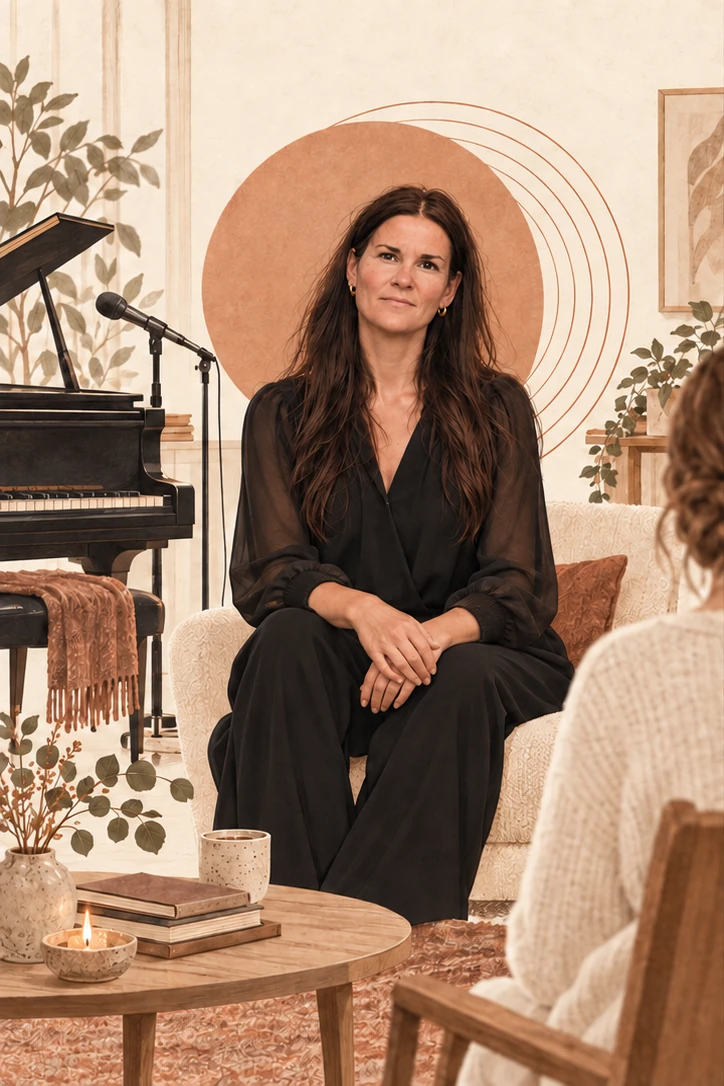
For many years I lived two different lives. One as a musician, artist, singing teacher and songwriter, and one as a clairvoyant healer where people pay me to read what is going on inside them. I discover that these worlds have more in common than I first thought, and that they strengthen each other. I can feel how contact with my own inner voice has strengthened my physical voice. I feel safer and more courageous. I no longer believe my piano teacher’s words. I continue the work of peeling away other people’s opinions and expectations. It feels good to listen to my own voice instead of everyone else’s.


Berlin
A new life in Berlin
I decide to move to Berlin to make a living from music. I need to get away from weekly visits to nursing homes and an overhanging fear of new defeats and death. I continue to strengthen my skills in singing, voice use, piano, intuition, healing abilities and songwriting. I play sold-out concerts, do solo tours lasting several weeks, and even play piano at a jazz festival. In between I take lessons with Thomas Lange, a German violinist who knows EVERYTHING about how the body can best be trained to be free to create music that resonates when it meets an audience.
At times I also teach singing, most often in a park in Neukölln near where I live. I cannot afford to rent a rehearsal room, but I enjoy every day in Berlin, the city where it is allowed to be yourself and do things your own way.

Family and farewell
The end and the beginning
One warm summer day I meet the man of my life at a barbecue at Fornebu in Oslo. I am only in Norway to play a concert, but meeting love trumps all plans. I give up my flat in Berlin and move to Norway.
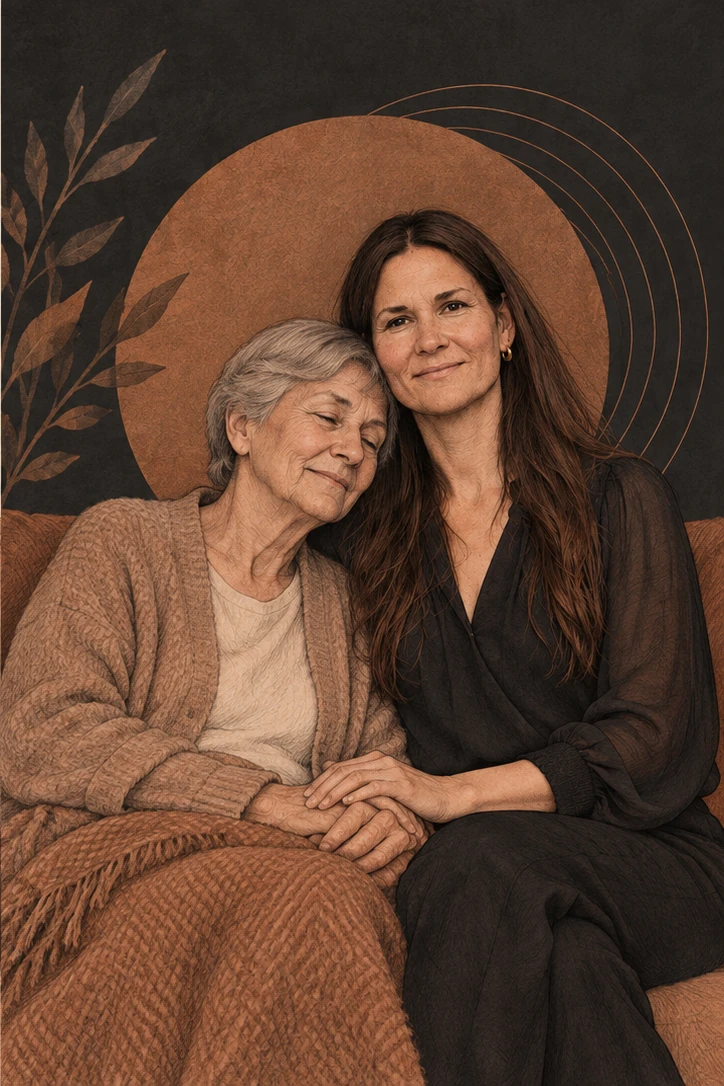
I manage to give Mum a grandchild and record three of my first albums. By then Mum has had a 15-year downward spiral of strokes, a broken ankle, repeated falls and bad news. In the end she loses her voice. She had cancer in the speech centre. I visit her as often as I can. Even though she no longer has a physical voice, I can communicate by reading her inner world. Seven years of training and dedicated practice have made me able to use my voice to convey what she wants to say. I read her as often as I can in the last four years before she dies on 4 January 2022.

The Leading Voice Method
How the Leading Voice Method came about
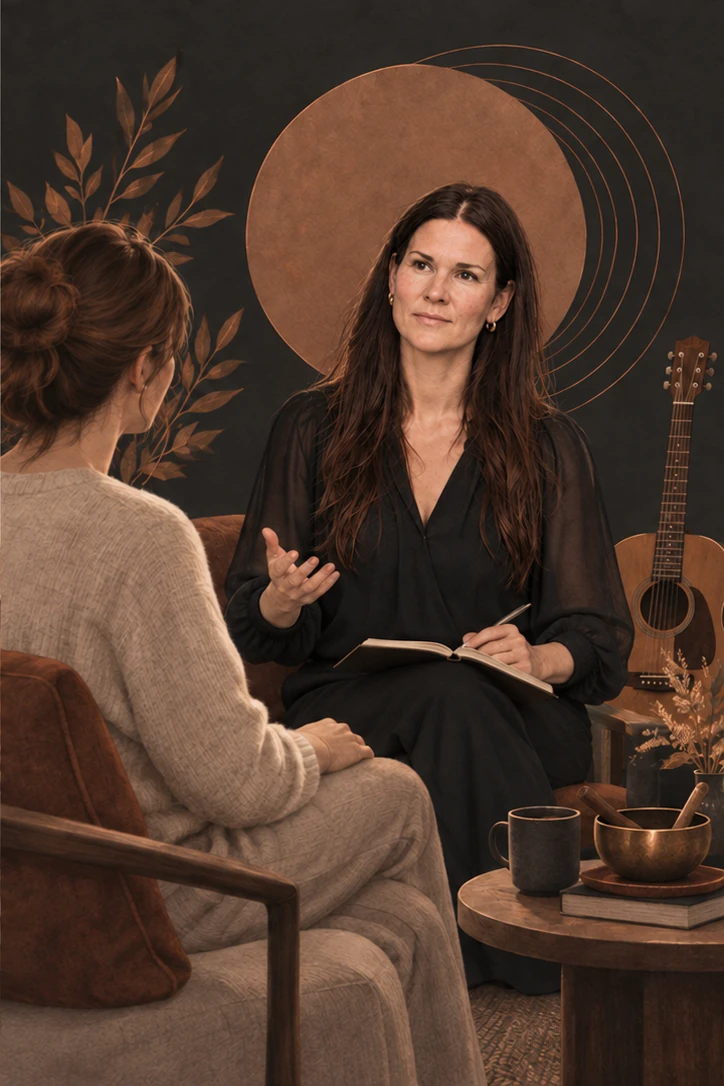
The Leading Voice Method came about from a wish to offer ALL my expertise connected to the voice. Beforehand I tested for several years the method of combining development of the inner and outer voice with both singers and actors. I could clearly see that they became more secure in themselves, on stage, in the meeting room and on home ground. I also realised that my expertise could help more people than just singers and actors. Top executives, founders and course leaders also became steadier by strengthening their inner and outer voice. The Leading Voice Method has therefore become a place for ambitious people who want to become more resilient, creative, optimistic and courageous.
It is a place where magic, possibility and freedom get to lead the way.
Ready to find your voice?
Explore the programmes, or get in touch for a no-obligation conversation.